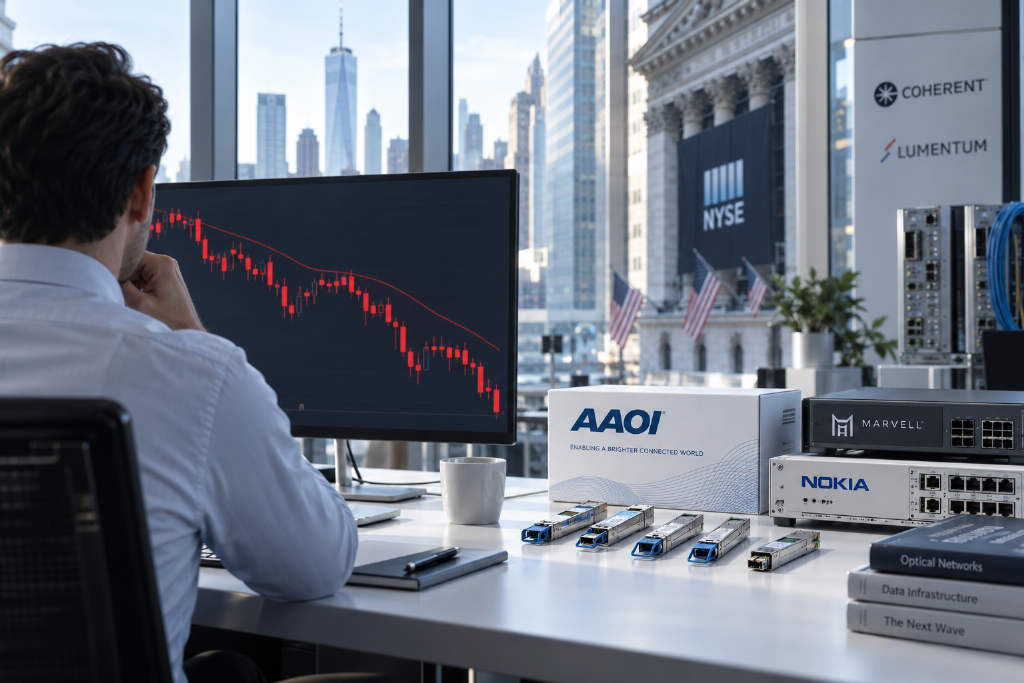
U.S. stocks2026-10-08 08:17:18U.S. optical module stocks fall in premarket trade, with AAOI down 3.78%Optical module and optical communications-related U.S. stocks mostly moved lower in premarket trading on Oct. 8, according to market data from BIT (Bit.com). Applied Optoelectronics (AAOI) posted the largest decline among the names listed, falling 3.78% to $117.91. Coherent (COHR) dropped 3.34% to $323.40, while Lumentum (LITE) was down 2.51% at $1083.23. Nokia (NOK) slipped 2.36% to $10.37, and Marvell (MRVL) fell 1.72% to $279.79. The move covered several stocks tied to optical modules and optical communications ahead of the U.S. market open.20
SpaceX2026-10-05 03:26:08Interview summary says SpaceX and xAI are building out their own AI supply chain as PCB and optical modules emerge as bottlenecksABMedia, citing a Substack roundup by WK of an internal expert interview involving SpaceX and xAI, reported that the group is targeting a sharp expansion in AI compute capacity over the next two years. The interview said current capacity is about 1.3GW, with plans to reach 2.3GW by December 2026, 4GW to 5GW by April to May 2027, and 10GW to 12GW by November to December 2027. A longer-term target of 20GW in 2028 was also outlined. The reported buildout is centered in the US, mainly in Memphis and Southaven, while land and permits in Texas have already been secured but construction has not started. Power plans mentioned in the interview include a mix of grid supply, gas turbines, Tesla solar, and Megapack backup. Of the first 10GW, around 60% is expected to be used internally by xAI, SpaceX, and Tesla, with the remaining 40% allocated to outside customers including Anthropic and Google. The interview also identified PCB, optical modules, transformers, and cooling hardware as the most difficult supply-chain constraints. It said the company has a 43-person supply-chain team and keeps a 20% to 40% inventory buffer for key hardware such as GPUs, while also exploring deeper vertical integration across cables, fiber, racks, and cooling systems.100
Goldman Sachs2026-09-14 12:23:31Goldman Sachs Raises High-Speed Optical Module Demand Forecast, Flags Supply Constraints for 2027Goldman Sachs sharply lifted its demand forecasts for high-speed optical modules after visiting 15 optical communications companies in China, saying demand for 800G and above modules will reach 144 million units in 2027 and 171 million units in 2028, up 39% and 36% from its prior estimates. The bank said demand is being driven by AI server rack expansion, a shift in network architecture from scale-out to scale-up with broader inter-layer interconnection, and the continued move toward higher transmission speeds. Goldman also expects 1.6T optical module pricing to stay above $700, while 800G products may see only a single-digit price decline by 2027. At the same time, it said the industry bottleneck is moving from demand to supply, with shortages in DSPs, lasers and PCBs likely to cap actual shipments in 2027. The firm added that leading manufacturers are locking in capacity through prepayments, long-term supply agreements and investments in suppliers, a trend that could reinforce industry concentration and support pricing. In CPO, Goldman expects switch shipments to rise from 10,000 units in 2026 to 92,000 in 2027 and 131,000 in 2028.960
FCC2026-09-11 11:39:15FCC final rule stops short of directly targeting major Chinese optical module makersThe U.S. Federal Communications Commission has formally released its final rule on equipment authorization and communications supply chain security, with publication set for Sept. 11 and the measure taking effect 30 days later. The outcome was less severe than many in the market had feared: core Chinese companies in the optical communications supply chain, including Eoptolink, Innolight, Suzhou Dongshan Precision Manufacturing and TFC Communication, were not directly placed on an FCC restriction list. The report says the immediate threat of a blanket ban has not materialized, even after the FCC moved optical transceiver modules into the Cover List control scope on July 22 and a draft proposal surfaced on Aug. 4 suggesting a ban on imports of new Chinese optical transceiver models. Still, the broader contest over supply chain security remains in place. A second and arguably deeper shift is unfolding at the same time. Co-packaged optics, or CPO, is moving toward mass production, led by companies such as NVIDIA and Broadcom. The article argues that while geopolitical restrictions may pressure Chinese suppliers, the more serious long-term challenge lies in the transition from pluggable modules to integrated optical-electrical architectures, especially as overseas foundries have already built out their positions in silicon photonics manufacturing.1470
Goldman Sachs2026-09-07 05:26:33Goldman Sachs raises optical module forecasts as rack-scale AI servers drive 1.6T and 3.2T demandGoldman Sachs has lifted its forecasts for the global optical module market, saying rising bandwidth demand in AI data centers is pushing the sector into a period of higher volumes and higher prices. In its September industry report, the bank now projects the market will reach $68 billion in 2026, $131 billion in 2027, and $148 billion in 2028, up 33%, 81%, and 115% from its previous estimates. The report ties the revision to three main factors: the expansion of rack-scale AI servers and ASIC servers, a higher number of optical modules required per GPU, and an ongoing migration toward 1.6T and 3.2T specifications. Goldman Sachs also raised its shipment forecast for 800G-and-above optical modules to 78.2 million units in 2026, 144 million in 2027, and 171 million in 2028. It also sees silicon photonics gaining share on cost advantages, with penetration in 800G-and-above modules rising from 68% in 2026 to 74% in 2028. CPO, or co-packaged optics, remains at an early stage, but Goldman Sachs expects its penetration to increase from 1% to 9% over the same period.2200
Goldman Sachs2026-09-07 04:03:53Goldman Sachs Raises Optical Module Forecasts as Rack-Scale AI and 1.6T Shift Gain PaceGoldman Sachs has lifted its projections for the global optical module market for 2026 through 2028, citing rising bandwidth demand in AI data centers, the spread of rack-scale AI servers, growing ASIC server deployments, and a transition toward higher-speed products such as 1.6T and 3.2T modules. In its September industry report, the bank raised its market value forecasts to $68 billion, $131 billion, and $148 billion for 2026, 2027, and 2028, up 33%, 81%, and 115% from its previous estimates. The report also increased expected shipments of 800G-and-above optical modules to 78.2 million, 144 million, and 171 million units over the same period. Goldman Sachs said the strongest growth is expected in 1.6T-and-above products, while 3.2T is set to become a key structural change in the market, reaching 40% of high-speed optical module shipments by 2028 from almost zero in 2026. The bank also pointed to the cost advantage of silicon photonics over EML-based designs and said CPO is starting to emerge as another technology direction. Goldman Sachs assigned buy ratings across multiple parts of the supply chain covered in the report.1770
storage2026-09-06 06:58:01Serenity: Storage Supply-Demand Tightness Persists, Short-Term Rally Doesn't Signal Bottleneck BreakthroughSerenity warned that the fundamental storage shortage remains unchanged and may worsen. Markets rotate across bottleneck sectors, but company fundamentals stay the same. Nikkei reported Japanese distributors see a 40%-60% demand gap, with prices potentially rising another 50% by year-end. SpaceX's capex excludes the ~$1.3 trillion from hyperscale cloud providers, suggesting total spending could exceed expectations. SanDisk's 80% gross margin target may hold through 2030, and Samsung and others have order visibility into 2031. Storage stocks are highly volatile; the same logic applies to optical modules, CW lasers, and substrates. A price rebound does not mean the shortage is over.950
GoPro2026-09-01 14:20:21GoPro Surges Over 80% on Plan to Merge With Starman Optical for AI Optical ModulesOn September 1, Serenity announced via a social media post that GoPro ($GPRO) plans to merge with photonics firm Starman Optical to enter the 800G/1.6T optical module market for AI data centers. The news drove GoPro's share price up by more than 80%. Serenity, as reported by BlockBeats, said the move caught it off guard, noting that 'GoPro competing with AAOI was absolutely not on my radar.' The leap from action cameras to AI data center optical communications is surprising, Serenity said, and the market's reaction to the transformation plan has been strong. The post, published on September 1, 2026, underscores the unexpected crossover between consumer electronics and AI infrastructure. GoPro's stock surge followed the announcement, which pairs the company with Starman Optical in a bid to challenge AAOI in high-speed optical modules used in AI data centers.920